Digital Ads: Your Complete Guide to Digital Advertising Platforms, Types, and Marketing Strategies
Oct 25, 2024


Digital ads are paid messages delivered across online channels to drive awareness, leads and sales by targeting people on search, social, display, video, audio and streaming platforms. This guide lays out why digital advertising is essential for measurable growth, how each ad format works, which platforms match specific goals, and which practical strategies improve ROAS and conversion rates. Many teams struggle to align audience intent with creative, measurement and budget discipline; this article fixes that by mapping ad types to use cases, platform strengths, KPI frameworks and 2025 trends like CTV, immersive formats and AI-driven optimization. You’ll get hands-on steps for audience segmentation, budget allocation, A/B testing, AI adoption and first-party data activation, plus clear metric definitions and tool recommendations. The sections that follow cover core ad types, platform-by-platform guidance, campaign design best practices, AI’s evolving role, the KPIs that matter, and the trends shaping digital media in 2025.
What Are the Main Types of Digital Advertising?

Digital advertising includes several distinct formats, each offering different mechanics, targeting strengths and creative requirements. Search ads capture active intent on results pages and use CPC bidding for direct response. Display and native ads rely on contextual placements and programmatic targeting to build reach and awareness. Video and CTV combine motion and sound to boost engagement and storytelling, while audio ads reach listeners in streaming and podcast environments where attention is primarily auditory. Shopping, retargeting and programmatic display tie product feeds, audience signals and dynamic creative together to drive commerce and conversions. Knowing these formats and how they work helps you pick the right ones for each funnel stage and ROI expectation.
How Do Search Ads Work and When Should You Use Them?
Search ads run on query-driven networks where advertisers bid to appear for keywords; auction results depend on bid, ad quality and expected impact, and most advertisers pay per click (CPC). Because search matches intent at the moment of need, it’s best for direct-response goals like lead generation, e-commerce transactions and local conversions where intent maps to measurable actions. To optimize search campaigns, group keywords into tight themes, write focused ad copy that mirrors intent, and send traffic to landing pages with clear conversion paths and tracking pixels for attribution. Track CTR and conversion rate to spot keyword relevance or landing-page friction, and use incremental bid automation to scale while holding CPA targets.
What Are Display, Video, and Native Ads?
Display, video and native ads differ by format, placement and creative needs, but they often work together across upper- and mid-funnel stages to build awareness and consideration. Display ads appear as banners or interstitials across sites and apps and are typically priced on CPM or viewable impressions, making them effective for reach and retargeting with concise visuals. Video ads — in-stream and out-stream — use motion and sound for storytelling and perform well when hooks and sequencing are optimized. Native ads blend with editorial content, matching form and function to reduce ad friction and increase engagement. Each format calls for distinct targeting and measurement approaches.
Different ad types pair with specific targeting and measurement goals:
Search ads prioritize intent signals and conversion metrics.
Display and native ads focus on CPM, viewability and remarketing audiences.
Video and CTV emphasize completion rates, view-through conversions and brand lift.
A concise comparison below highlights each ad type’s typical use case, pricing and targeting strengths.
Digital ad types compared by use-case, pricing, and targeting strengths.
Ad Type | Best Use Case | Typical Pricing Range | Targeting Strength |
Search Ads | Direct response, e-commerce conversions | CPC: varies by keyword | High intent targeting |
Display Ads | Reach, retargeting, awareness | CPM: $1–$10+ | Contextual + behavioral |
Video Ads | Brand storytelling, engagement | CPV/CPM: $0.01–$30 | Demographic + interest |
Native Ads | Content-aligned promotion | CPM/CPC: moderate | Contextual + editorial fit |
CTV Ads | Streaming reach, upper-funnel | CPM: $20–$50+ | Household + device-level |
Audio Ads | Podcasts, streaming listeners | CPM: $5–$30 | Interest + contextual audio |
Which Digital Advertising Platforms Should You Choose?
Picking the right platform means matching audience, format and measurement to your business goals and creative assets. Google Ads excels at query intent and shopping integrations across search and display, so it’s often the go-to for performance marketers focused on direct response and e-commerce. Meta Ads are strong for interest and demographic targeting across feeds and short-form video, supporting both upper-funnel reach and lower-funnel retargeting. TikTok emphasizes discovery-driven short videos and creator formats that reward strong creative hooks and trend alignment for brand lift. Microsoft Advertising can deliver lower CPCs on search and offers LinkedIn-style audience segments useful for B2B intent, while programmatic platforms tie inventory across exchanges for scale and audience-based buying.
When choosing platforms, weigh creative fit, audience concentration and measurement maturity. The table below compares major platforms by audience, formats, targeting options and ideal business types to help prioritize where to invest.
Platform comparison to match format, targeting, and business objectives.
Platform | Core Audience | Supported Formats | Targeting Options |
Google Ads | Broad search intent + shoppers | Search, Display, Video, Shopping | Keywords, audiences, first-party signals |
Meta Ads | Social audiences, visual-first | Feed, Stories, Reels, Video | Demographics, interests, custom audiences |
TikTok Ads | Younger, discovery-focused | Short video, in-feed, branded effects | Interest, behavior, creator partnerships |
Microsoft Advertising | Professional and desktop users | Search, Shopping, Audience ads | LinkedIn profile targeting, keywords |
What Are the Key Features of Google Ads and Microsoft Advertising?
Google Ads offers a broad ecosystem — search, Performance Max, display and Shopping — that links product feeds and Merchant Center data to discovery and purchase paths. Its strengths are query-level intent signals, a mature auction system and automated bidding that can optimize for conversions or ROAS when conversion data is reliable. Microsoft Advertising provides competitive search inventory, often with lower CPCs and audience segments tied to professional profiles, making it useful for B2B and desktop-focused conversions. Both platforms support audience signals, automated bidding and remarketing, but differences in reach, audience mix and merchant integrations affect which will deliver the best incremental return.
How Do Meta Ads and TikTok Ads Differ?
Meta Ads lean on profile-based targeting and offer versatile creative units like carousels, collections and stories, plus robust retargeting across Facebook and Instagram — which suits commerce brands with strong visual assets and established pixel tracking. TikTok prioritizes short-form video surfaced through algorithmic discovery rather than explicit intent, rewarding native-feeling, trend-aware creative that blends into feeds. Meta’s advantage is deterministic audiences and diverse ad formats; TikTok’s is rapid organic reach and high engagement on discovery placements. Test both with small budgets and creative variations to find platform-specific creative winners.
How Can You Develop Effective Digital Marketing Strategies for Ads?

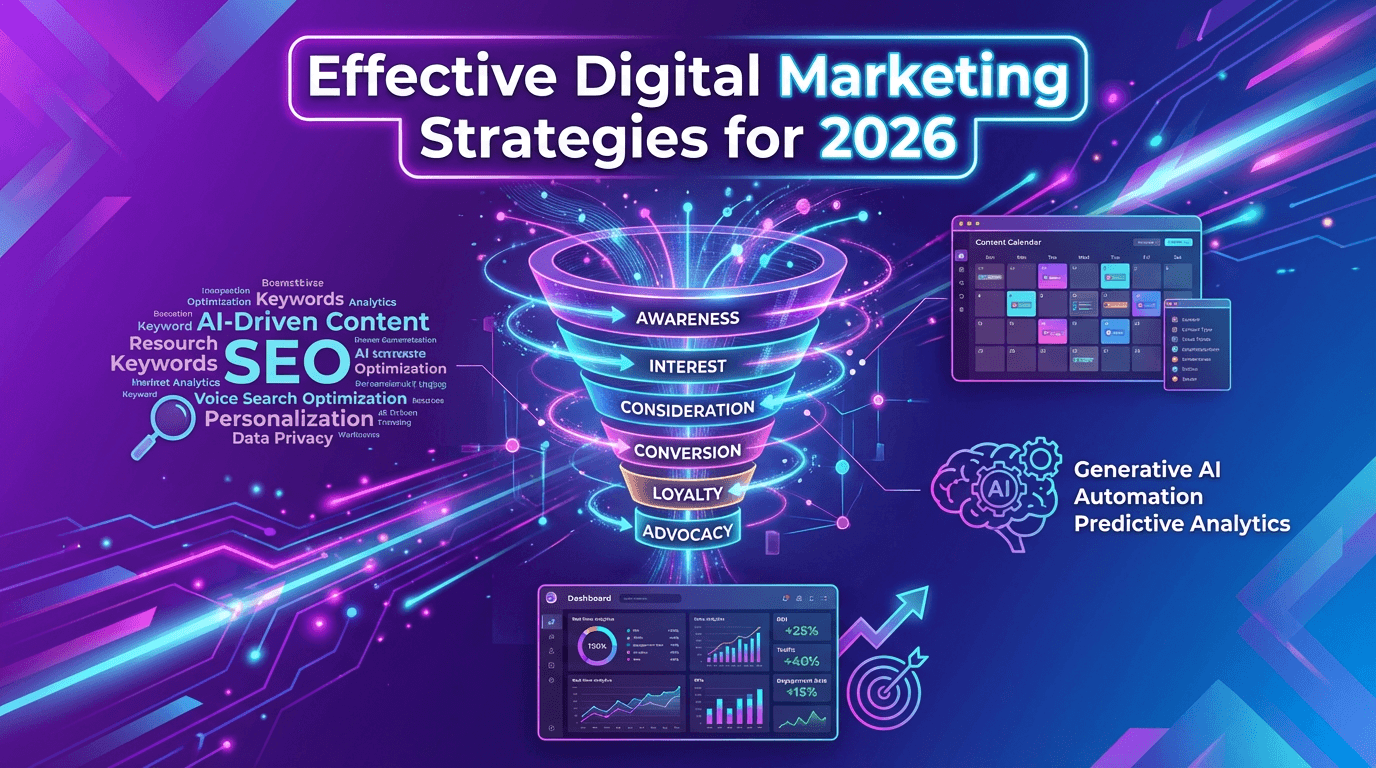
Effective ad strategies start with a clear business objective and map audience, creative and budget to measurable goals. Define funnel-stage outcomes — awareness, consideration, conversion — and assign KPIs and budget shares to each stage to avoid overpaying for low-value impressions. Use first-party CRM data, platform signals and modeled lookalikes to build targeted cohorts, and craft creative that fits intent: strong hooks for awareness, educational messaging for consideration and direct CTAs for conversion. Close the loop with iterative testing and analytics: a steady A/B testing cadence and reliable measurement turn learnings into scalable improvements across campaigns and platforms.
Core strategy elements include audience research, budget rules, creative workflows and testing processes that create repeatable optimization cycles. The checklist below summarizes the essential planning steps.
Core strategy checklist for ad campaign planning and optimization.
Set clear funnel-stage objectives and map KPIs to each stage.
Segment audiences with first-party data, platform signals and lookalikes.
Allocate budgets using a funnel split and reserve funds for tests.
Build creative variants tailored to platform formats and user intent.
Implement tracking and measurement pipelines before scaling spend.
Following these steps helps align audience, creative and measurement so your ad program delivers predictable, scalable ROAS.
What Are Best Practices for Audience Targeting and Budgeting?
Start by collecting and normalizing first-party signals — website events, CRM segments and email lists — then complement those with platform behavior and contextual signals where useful. Segment by intent, recency, purchase propensity and LTV potential to prioritize offers and creative. For budgeting, consider a simple funnel allocation (for performance-focused teams): 60% conversion, 25% consideration, 15% awareness — and adjust gradually as channel data validates ROAS. Use automated bidding once conversion data is sufficient, keep manual controls during experiments, and hold back incremental test budgets to validate new channels or creative without disturbing baseline performance.
Machine learning can significantly boost these targeting and budgeting approaches by predicting user behavior and optimizing delivery.
Machine Learning for Predictive Ad Targeting in Programmatic Advertising
This study examines how machine learning (ML) improves predictive targeting within programmatic advertising. Traditional methods often struggle to forecast user behavior and deliver relevant ads at scale. By testing supervised and unsupervised ML models — including decision trees, neural nets and clustering — the research evaluates improvements in ad relevance, engagement and budget efficiency. Results show ML-driven targeting raises click-through and conversion rates versus conventional techniques, highlighting ML’s role in sharpening audience precision and reducing wasted spend.
Optimizing programmatic advertising: A machine learning approach to predictive ad targeting, A Singhal, 2024
How Does A/B Testing Improve Digital Ad Performance?
A/B testing isolates variables like headlines, creatives, CTAs and landing pages to find the changes that move conversion metrics. Run tests with a clear hypothesis, defined success metric, controlled variant rotation and adequate sample size for statistical confidence. Change one element at a time for clear causality, let tests run long enough to capture normal traffic cycles, and use platform experiment tools or third-party testing systems to reduce bias. Common mistakes include underpowered tests, changing multiple variables at once and drawing conclusions too early. Properly designed tests produce durable insights you can scale across campaigns and channels.
How Is AI Transforming Digital Ads in 2025?
In 2025, AI accelerates personalization, automates bidding and budget allocation, and generates scalable creative variants that boost relevance and shorten production time. Machine learning models ingest behavioral and contextual signals to predict conversion likelihood, enabling automated bidding that seeks higher ROAS by adjusting bids in real time. Generative AI speeds up ad copy, image variations and video storyboards for rapid A/B testing, while predictive LTV models improve audience scoring for more efficient media buys. These systems rely on clean first-party data and solid measurement pipelines to prevent model drift and ensure accountable outcomes.
AI adoption also brings governance and measurement changes: validate models against business outcomes, set brand-safety guardrails and monitor performance continuously. Below are concrete AI-driven capabilities to prioritize in 2025.
Key AI capabilities reshaping digital advertising in 2025.
Dynamic creative personalization that assembles asset combinations based on user signals.
Predictive bidding and budget automation that shift spend toward higher-LTV audiences.
Generative creative workflows that shorten time-to-market for ad variants and tests.
Adoption requires preparing data feeds, labeling outcomes consistently and adding monitoring to prevent unintended creative or bidding behaviors.
What Role Does AI Play in Personalization and Automation?
AI personalizes ads by combining signals — search intent, past behavior, CRM attributes — into predictive scores that guide content selection, creative assembly and offer personalization in real time. Automation kicks in when models continually adjust bids, pause underperforming variants and reallocate budgets to maintain CPA or ROAS targets, freeing teams to focus on strategy and creative direction. Implement governance through parameter limits, human review for brand-sensitive assets and regular retraining on recent outcomes to keep automated decisions aligned with business goals.
How Can Marketers Leverage AI for Better ROI and Conversion Tracking?
To improve ROI, deploy AI for attribution modeling, anomaly detection and predictive LTV scoring to inform bids and audience prioritization. Prepare high-quality, privacy-compliant first-party datasets and map events to business outcomes so models learn accurately. Use AI-powered dashboards and alerts to flag underperforming segments or sudden bid inflation, and validate model recommendations with controlled experiments to confirm incremental lift before full rollouts.
What Metrics and KPIs Should You Track to Measure Digital Ad Success?
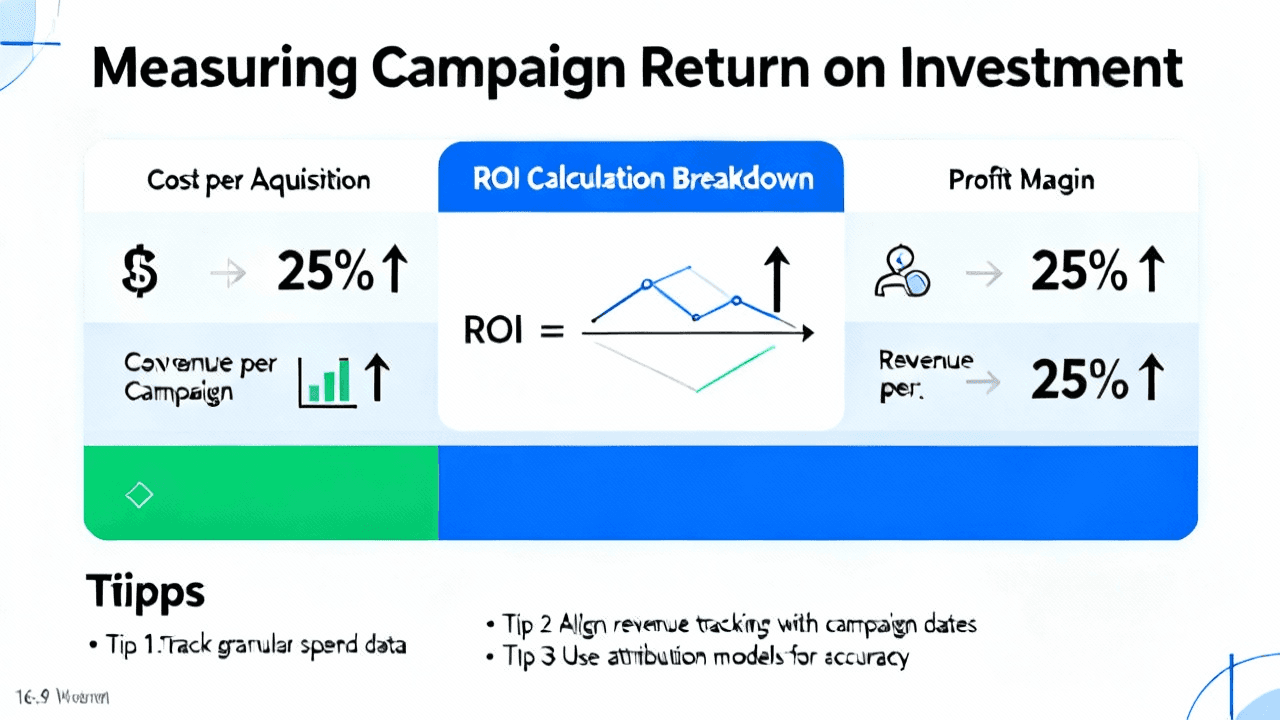
Measure success with KPIs that map directly to campaign objectives and translate platform metrics into business outcomes using consistent definitions and tracking. ROAS, CPC, CTR, conversion rate, CPA and LTV together describe efficiency, engagement and value. ROAS (revenue divided by ad spend) shows financial return; CTR and conversion rate diagnose creative relevance and landing-page effectiveness. Pair these metrics with attribution models and cohort-based LTV analysis to prioritize investments that scale profitably. The table below maps common KPIs to campaign goals for clarity.
Mapping KPIs to campaign objectives for clearer evaluation.
KPI | Definition | Best-used For |
ROAS | Revenue / Ad Spend | E-commerce and revenue-focused campaigns |
CPC | Cost per click | Search and performance campaigns optimization |
CTR | Click-through rate | Creative relevance and audience targeting |
Conversion Rate | Conversions / Clicks | Landing page and funnel efficiency |
CPA | Cost per acquisition | Lead-gen and CPA-targeted campaigns |
How Do ROAS, CPC, CTR, and Conversion Rates Impact Campaign Evaluation?
ROAS shows revenue efficiency, while CPC and CTR give early signals about ad relevance and audience fit. A low CTR with high CPC often points to misaligned targeting or weak creative; a high CTR but low conversion rate suggests landing-page friction. Use metric combinations diagnostically: low CPC plus low conversion rate implies quality issues on the landing experience, while high ROAS but low volume signals scaling constraints you can address with lookalike expansion or broader tests. Define alert thresholds for each metric and attach optimization playbooks — creative iteration, landing-page experiments or audience refinement — to those triggers.
What Tools Help Monitor and Analyze Digital Advertising Performance?
A robust monitoring stack includes platform-native dashboards, a centralized analytics solution with consistent event definitions, and visualization/reporting tools for stakeholders and anomaly detection. Analytics platforms consolidate conversion events and support attribution modeling; visualization tools build cross-channel dashboards that surface trends and alerts; ad management and bid automation tools handle operations. Good integration hygiene — consistent event naming, server-side tagging where needed, and regular data audits — ensures both automated systems and analysts work from the same accurate dataset.
What Are the Latest Digital Advertising Trends to Watch in 2025?
In 2025, digital ads are shaped by AI-driven personalization, rapid growth in CTV and streaming inventory, emerging immersive formats (AR/VR), and a stronger emphasis on first-party data because of privacy changes. Marketers should prepare for voice-driven interfaces and conversational ad experiences that change keyword strategies, and run early immersive pilots with new creative and measurement approaches that capture engagement beyond clicks. First-party data and consent-based targeting are increasingly essential as third-party cookie deprecation limits cross-site behavioral tracking — so invest in CRM integration and contextual targeting to preserve reach.
These trends demand action: improve data quality and consent flows, pilot CTV and immersive formats with clear KPIs, and adopt AI responsibly with brand safety and human oversight.
How Will Voice Search and Immersive Marketing Change Digital Ads?
Voice search shifts focus from typed keywords to conversational queries and intent signals, so optimize content and bids around natural language and contextual triggers instead of exact-match terms. Immersive marketing — AR/VR and interactive CTV overlays — changes creative needs by requiring experiential assets and new measurement metrics like dwell time, interaction events and post-experience conversions. Run early pilots with clear KPIs, small controlled tests and reusable creative modules to keep production efficient and measure true incremental engagement.
Why Is First-Party Data Becoming Essential for Digital Advertising?
First-party data provides deterministic signals — purchase history, email engagement and onsite behavior — that underpin reliable targeting and model training in a privacy-first world. Build a first-party strategy by collecting consented signals through clear opt-ins, integrating CRM data with analytics and enriching profiles with contextual and behavioral feeds while respecting privacy. Practical steps include implementing consent management, standardizing event schemas and building audience segments that can be activated across platforms, blending first-party signals with contextual targeting to retain reach without relying on deprecated third-party identifiers.
Relying on direct, permissioned relationships ensures your models and campaigns remain effective in 2025 and beyond, rather than depending on fragile cross-site identifiers.
Frequently Asked Questions
What are the benefits of using programmatic advertising?
Programmatic advertising automates buying and selling ad space so you can bid in real time and place ads more efficiently. It improves targeting by using data to reach audiences based on behavior and intent, and it can optimize spend dynamically to improve ROI. Because performance data is available in near real time, you can make faster adjustments to creative, bids and placements to reduce wasted budget and improve campaign outcomes.
How can businesses measure the effectiveness of their digital ads?
Measure effectiveness using KPIs that match your goals: ROAS, CTR, conversion rate and CPA are common choices. Analyze those metrics alongside attribution models to see which channels and touchpoints drive conversions, and use cohort LTV analysis to understand long-term value. Consistent event definitions and reliable tracking are critical so metrics translate into real business outcomes.
What role does audience segmentation play in digital advertising?
Segmentation lets you tailor messages to groups based on demographics, interests and behaviors, creating more relevant ads that perform better. It also helps you prioritize budget toward higher-value audiences and test creative variations for specific cohorts. Well-designed segments increase engagement, lift conversion rates and make your media spend more efficient.
How can businesses effectively utilize first-party data in their advertising strategies?
Use first-party data to improve targeting and personalization by integrating customer interactions, purchase history and preferences into your ad platforms. This data, collected with consent, lets you build deterministic audiences, personalize creative and measure outcomes more accurately. Proper consent management and privacy controls make first-party data a reliable foundation for campaigns in a post-third-party-cookie world.
What are some common pitfalls to avoid in digital advertising campaigns?
Common pitfalls include unclear objectives, poor audience targeting and insufficient testing. Without clear goals, campaigns drift and budgets get wasted. Neglecting segmentation or A/B testing means you miss optimization opportunities, and relying on a single channel limits reach. Build a testing plan, define measurable objectives and diversify placements to avoid these traps.
How can businesses stay updated with the latest digital advertising trends?
Stay current by following industry publications, attending webinars and conferences, and subscribing to newsletters from trusted sources. Engage with peers and thought leaders on social platforms and join professional communities to share learnings. Continuous learning and small, controlled experiments will help you adopt new tactics and technologies effectively.
Conclusion
Digital advertising remains one of the most direct ways to reach and convert audiences across platforms. By understanding ad types, matching platforms to objectives, and applying disciplined measurement and testing, teams can improve engagement and scale profitable outcomes. Prioritize first-party data, pilot CTV and immersive formats thoughtfully, and adopt AI with governance in place to get better results without sacrificing brand safety. Explore these resources and put the checklist into practice to elevate your digital ad program.